Quick. When you think of Chichen Itza, what comes to your mind? Maybe Mayan ruins. Maybe Mexico. Maybe the Yucatan Peninsula.
Well, a lot of different thoughts can come to your mind. But, I am almost sure that when you thought about these famous ruins, an image from its most famous structure, El Castillo, came to your mind.
The thing is that this ancient Mayan city is full of amazing temples, pyramids, and structures. I don’t know why tourism boards encapsulate the magnificence of this city in one structure.
That is why I feel like giving you a private tour of the site. I absolutely loved every inch of this Mayan city. I didn’t leave without exploring every corner and discovering structures in different levels of decay. If you have visited the site, you understand how I feel.
A Little Background
Chichen Itza means “at the mouth of the well of the Itza”. Historically, the Itza were an important Mesoamerican people who dominated the Yucatán peninsula in the Post-classic period. The Itza may have originated from the Classic Period near Lake Peten Itza in Guatemala, migrating to Yucatán during the Maya collapse at the end of the Classic Period. From their capital, at Chichén Itzá they established a trade empire reaching as far south as Honduras.
The site exhibits many architectural styles that point to influence from other cultures. Today, this once-powerful capital is a UNESCO World Heritage Site and one of the most visited places in Mexico.
Let’s take a look at what you can expect to see in the north architectural group.
El Castillo
Even though I don’t like that Chichen Itza is mostly associated with this structure, I can’t deny it is beautiful, awesome, and impressive. When you enter the site, this is the first thing you are going to see. Hold your chin. If may drop abruptly. For me, the perfect symmetry of the structure is what makes it special. It also has a lot of hidden secrets.
A guide can help explain all this better. For example, clapping in front of the staircase of the El Castillo pyramid is followed by an echo that resembles the chirp of a quetzal (try it if you go, it works!!!).
Interesting fact: The actual Maya structures are property of the federal government but the land where the structures are located is owned by the state of Yucatan.
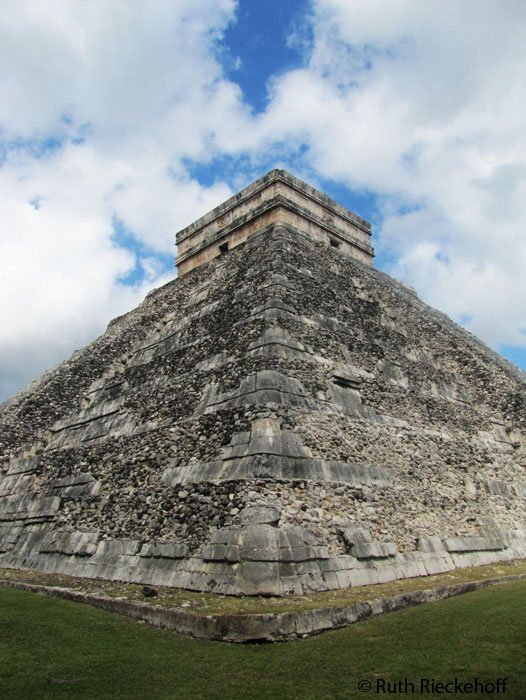
El Castillo see from the side
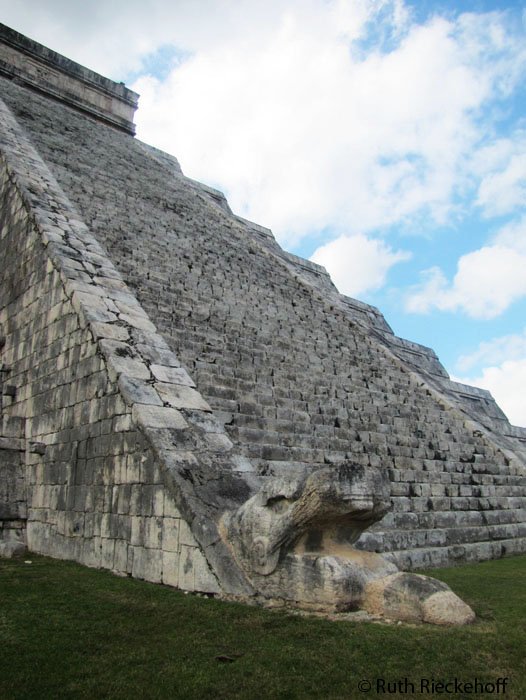
The feathered serpent at the bottom of El Castillo
Temple of the Warriors
This structure consists of a pyramid fronted and flanked by rows of carved columns depicting warriors. Remember to pay attention to its detailed carvings.
Interesting fact: The Temple of the Warriors is basically a copy of a temple located in the Toltec capital (but on a greater scale).

Temple of the Warriors
Group of a Thousand Columns
There are many columns next to the Temple of the Warriors. Experts believe these columns supported a big roof at one moment in time.
Interesting fact: All the signs (with descriptions) in Chichen Itza are in Spanish, English, and Maya (which I think is great).
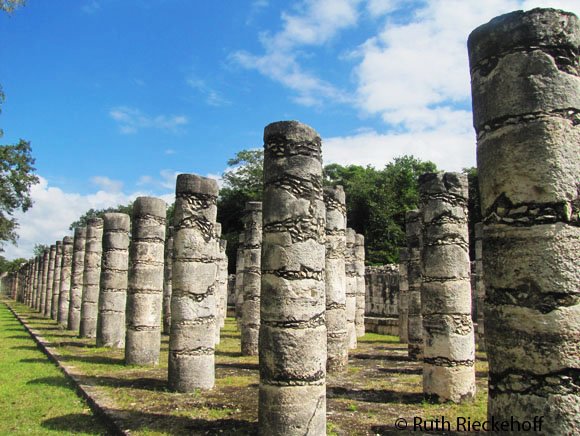
Group of a Thousand Columns
El Mercado
These are the tallest columns on the site. It was believed to be a market because of the gallery and patio style it presents. Today, archeologists are not sure of its real purpose.
Interesting fact: Chichen Itza is probably one of the mythical cities the Mayas describe in later literature.
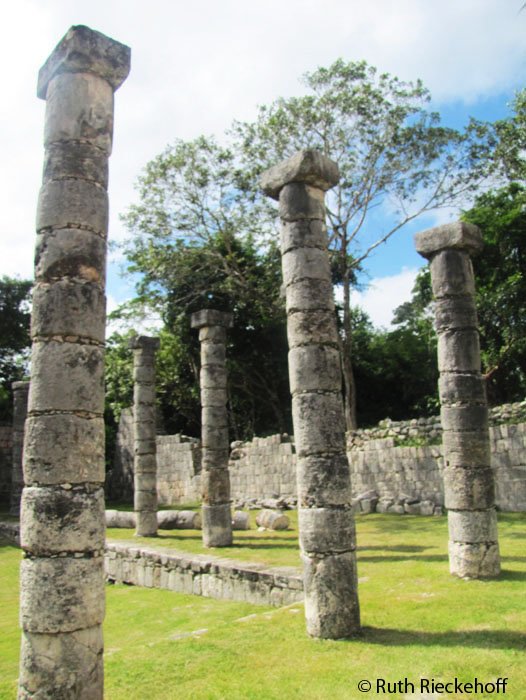
Columns at El Mercado
Sacred Cenote
This was the sacred sinkhole of the city. A great number of objects and human remains were found during different excavations. After the collapse of the city, it became a pilgrimage place.
Interesting fact: Both the Mayas and the Aztecs revered serpents.
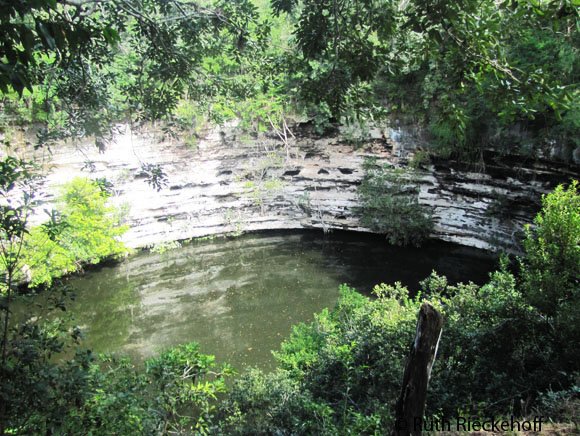
Sacred Cenote
Tzompantli or Skull Platform
This is a small platform covered in skulls. It shows influence from Central Mexico.
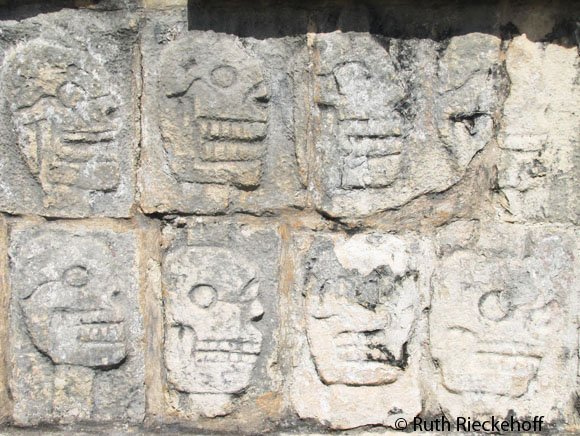
Skull Platform
Temple of the Tables
Temple showing a jaguar procession, among trees and weapons.

Jaguar Procession
Great Ball Court
This is the biggest ball court in Mesoamerica. Actually, 13 different ball courts have been identified in Chichen Itza. So they must have loved this game.
Interesting fact: The stone ring (where the players were supposed to pass the ball thru) is 30 feet (9 meters) from the ground. Imagine the level of fitness and skill needed to play in that ball court.
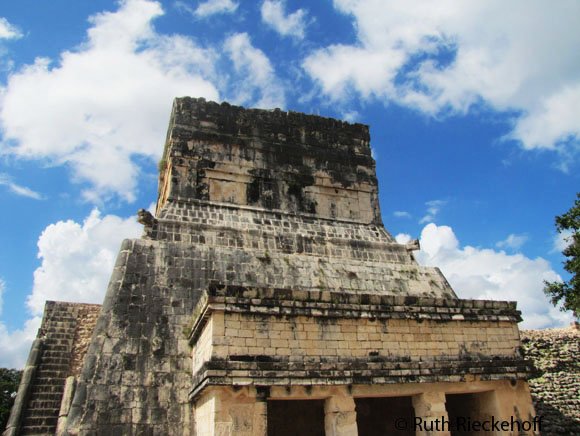
Back of ball court

Stone Ring at Ball Court
Don’t miss the second part of my private tour of Chichen Itza if you want to learn more about this amazing city.
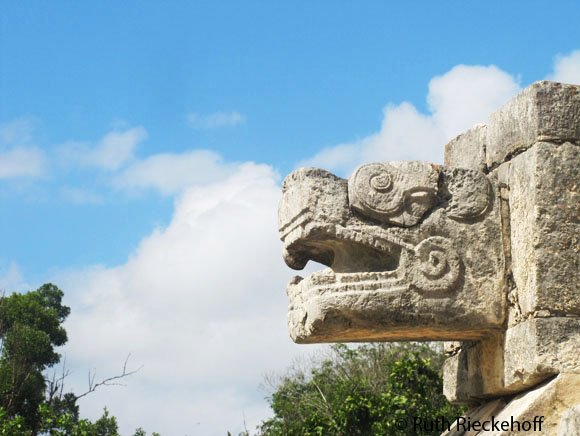
Jaguar Carving
South or Ossario Group
Ossario
The ossario is a step pyramid similar in features to El Castillo but on a smaller scale. There is a temple on top and at the structure’s center, there is an opening that leads to a natural cave. Archeologists have found several skeletons and artifacts inside the natural hole. See, one of the many secrets this city holds!!
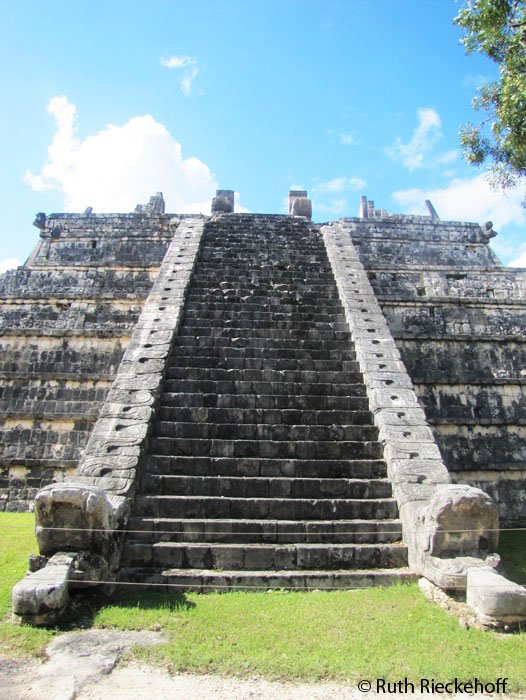
Ossario
Mascarones del Ossario (Ossario’s Masks)
Next to the Ossario, you can find a beautiful carve column. This was a piece that was located at one of the top corners of the Ossario. There used to be 16 of these columns (4 at each side). The carvings represent Chaac (the rain god) and other supreme powers. The carving style is Puuc (Mayans who used to live in a hilly area of the Peninsula). Take a moment to admire this piece of art.
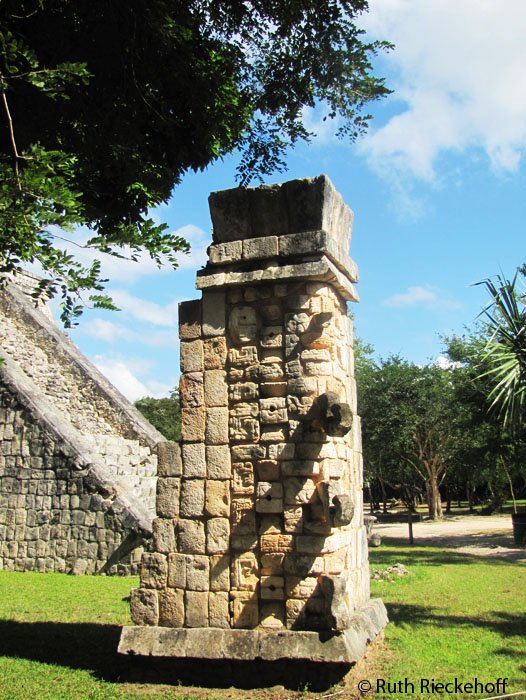
Ossario’s Masks
Casa Colorada (Red House)
This is one of the best-preserved buildings in the complex. The name comes from the red pigment found inside the structure. Its Maya name is Chichanchob may mean “small holes”. Experts believe the original Maya name comes from the intricate carvings at the top of the building (more Puuc style).
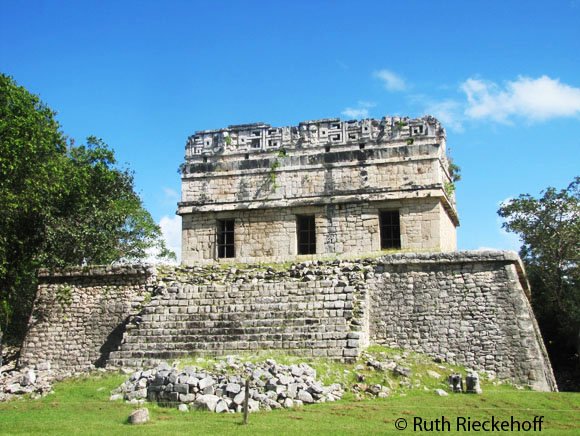
Casa Colorada
Casa de Venado (Deer’s House)
Well, this building is not as preserved as the Casa Colorada. The name comes from, you guessed it, a deer painting found in one of the rooms.
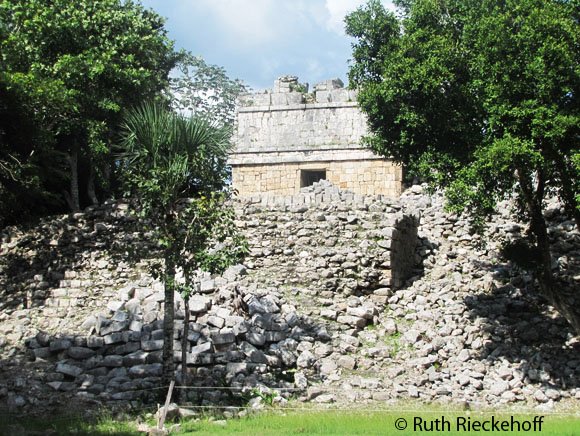
Casa del Venado
Central Group
Las Monjas
This is a complex of Terminal Classic buildings constructed in the Puuc architectural style. The Spanish nicknamed this complex Las Monjas because one of the buildings has a façade that resembles a nunnery. We know it was actually a governmental palace.
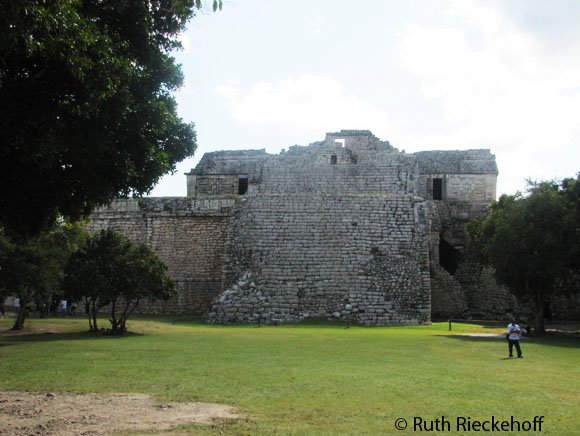
One of the buildings in the Las Monjas complex
La Iglesia (The Church)
This small building with only one chamber owes its name to its proximity to the so-called “convent” of the Nunnery and to the exuberant decoration on its upper façade, which rises even higher due to its lofty roof comb. There are a lot of hidden messages (hieroglyphs) in this small structure. This was one of my favorite parts of Chichen Itza.

The Nunnery and the Church
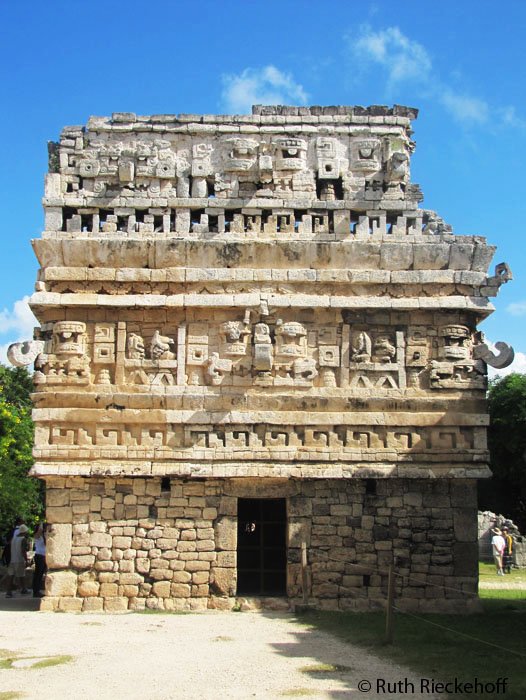
The Church
El Caracol (The Snail)
I thought this place was called the observatory. Well, the official name is “The Snail” because of some spiral stairs on the inside. This building is so similar to modern-day celestial observatories. Experts believe it was used as a proto-observatory with doors and windows aligned to astronomical events, specifically around the path of Venus as it traverses the heavens. Totally fascinating.
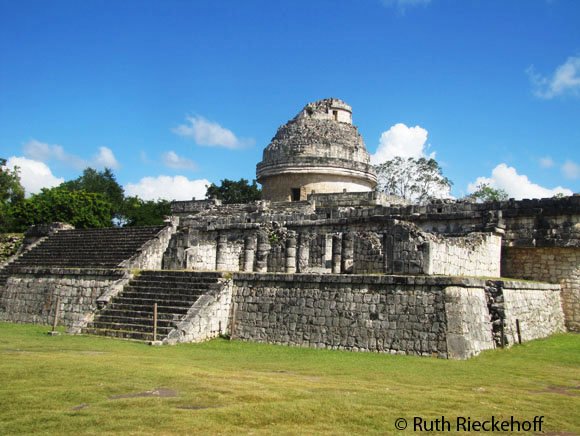
El Caracol
I almost miss this place (and the entire Monjas complex). However, before my visit, I knew the structure was in the complex. Therefore, I asked a vendor and he explained what path to take.
Remember: if you visit this place, the main path is going to take you to El Castillo and all the buildings I explained in the first part of this tour. But make sure once you also visit the central and south areas. Don’t miss them!!
Well, this is the end of the tour (sniff, sniff). Hope you liked it (and learned new things). Promise you will go ready to explore Chichen Itza next time.
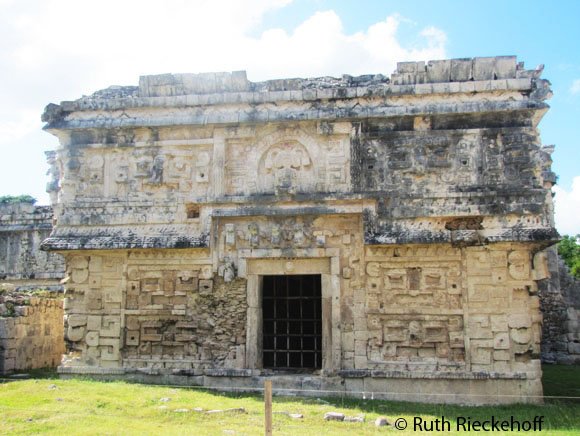
Puuc Style Building
Have you visited Chichen Itza? What surprised you about the city? Let me know in the comments section below.


adventureswithben says
The skull platform looks very cool!
Cathy Sweeney says
Chichen Itza is one of the most fascinating places I’ve ever been. I didn’t know about clapping in front of the staircase to get the echo. But I did climb the stairs at El Castillo. Going up was OK, but coming down was pretty scary.
Courtney Mroch says
WHOA! This place looks as neat as what I’ve read about it. We didn’t get to go there. It was too far from where our cruise took us, so we did Chacchoben instead. Which was still neat, but this also looks amazing!
Debbie Beardsley @ European Travelista says
I would love to visit Chichen Itza! I haven’t had the opportunity to dig into the history of this area but it is fascinating. Thanks for the information and pictures!
Mark Wiens says
Cool, thanks for that historical background lesson about Chichen Itza and the great photos. It’s a place I’ve never been but hopefully will visit someday!
Private Tour says
Nice pictures..and great place for hang out…